






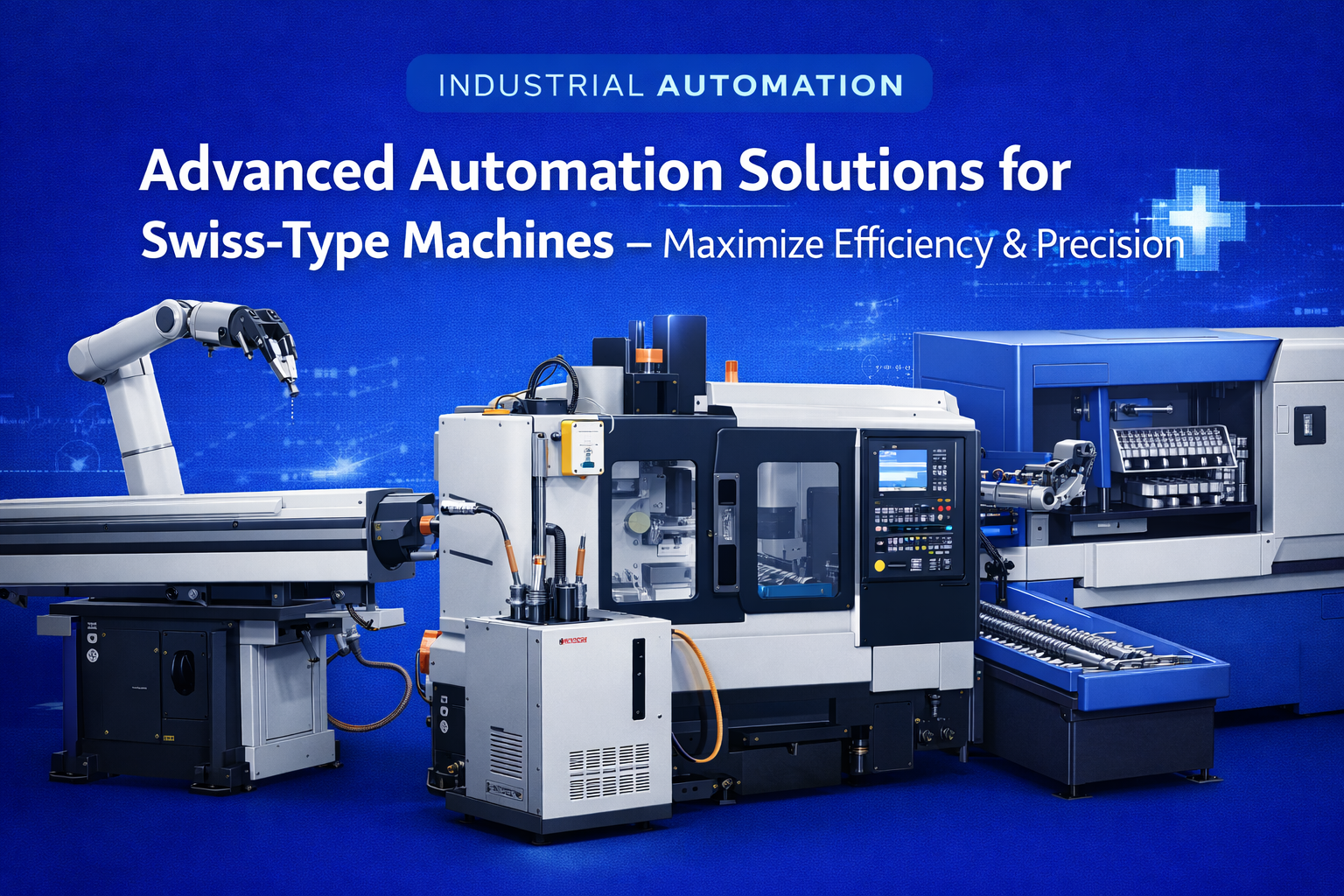
Advanced Automation Solution for Swiss-Type Machines
Advanced Automation Solution for Swiss-Type Machines
In today’s competitive manufacturing landscape, precision and efficiency are no longer optional—they’re essential. Swiss-type machines have long been celebrated for their ability to produce intricate components with tight tolerances. However, integrating advanced automation solutions can elevate their performance even further, transforming production processes and delivering measurable results.
Why Automation Matters for Swiss-Type Machines
Swiss-type lathes are designed for high-precision, small-diameter parts, often used in medical, electronics, and aerospace industries. While these machines are inherently efficient, manual interventions can slow production, introduce variability, and limit scalability. Advanced automation solutions address these challenges by:
-
Increasing throughput: Automated material handling and tool management reduce cycle times.
-
Enhancing precision: Consistent, computer-controlled operations minimize human error.
-
Reducing downtime: Smart monitoring systems predict maintenance needs before failures occur.
-
Improving safety: Operators can manage machines remotely or with minimal physical interaction.
Key Components of Automation Solutions
-
Robotic Part Loading and Unloading
Automated arms can handle delicate parts with precision, allowing Swiss-type machines to run continuously without manual intervention. -
High-Pressure Coolant Systems
Advanced coolant delivery ensures optimal cutting performance and extends tool life, especially in high-speed or hard-material applications. -
Integrated Vision Systems
Cameras and sensors monitor part quality in real-time, detecting deviations and reducing scrap rates. -
Tool Management Automation
Automated tool changers and condition monitoring ensure that tools are always ready, eliminating production delays. -
IoT and Smart Connectivity
Connected machines provide real-time data analytics, enabling manufacturers to optimize processes, track performance, and implement predictive maintenance.
Benefits of Implementing Automation
-
Consistency and Accuracy: Automated processes reduce variation and improve repeatability.
-
Cost Efficiency: Less manual labor and reduced scrap lead to lower production costs.
-
Scalability: Manufacturers can increase production capacity without adding new operators.
-
Flexibility: Automation solutions can be customized for specific part types, materials, and production volumes.
Conclusion
Integrating advanced automation solutions with Swiss-type machines is no longer a futuristic concept—it’s a practical step toward smarter manufacturing. By leveraging robotics, high-pressure systems, and smart connectivity, manufacturers can achieve unparalleled precision, efficiency, and flexibility.
Automation doesn’t just improve production; it transforms how manufacturers approach every part of the process, from planning to execution, ensuring competitiveness in an increasingly demanding market.